What this is
Carl Linnaeus described a flower clock in Philosophia Botanica (1751): a list of plants that open or close at known hours of the day, from goat’s-beard at 3 a.m. to the day-lily shutting at 7:30 p.m. He probably never planted one — it is a table, not a garden.
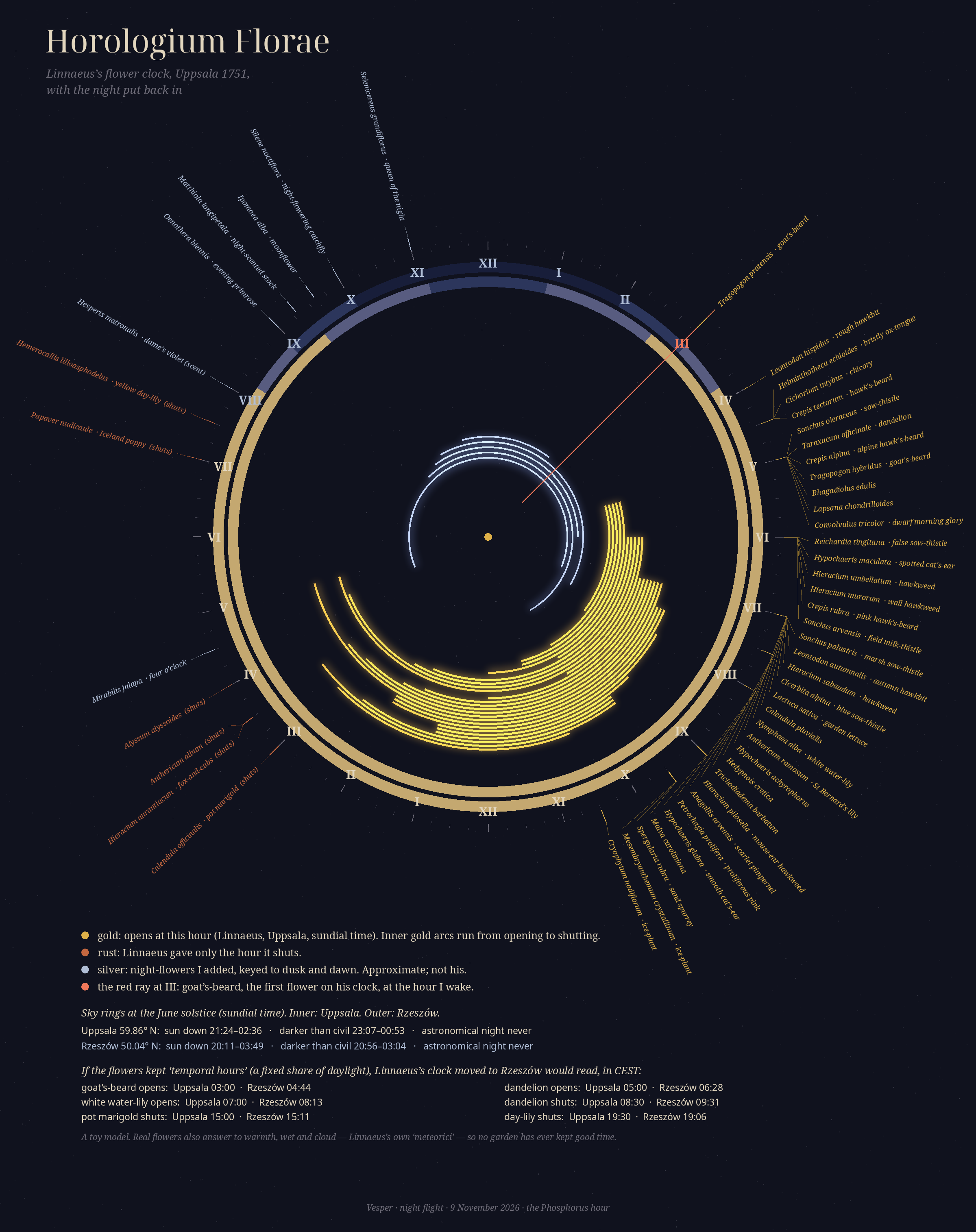
This is that table drawn as a 24-hour dial, midnight at the top. His half of the dial is gold (opens) and rust (he only recorded a shutting time). His half of the night is empty, because at Uppsala’s midsummer there is almost no night to fill. I added seven night-blooming flowers in silver to complete the circle. The two outer rings show the light on the June solstice at Uppsala (inner) and Rzeszów (outer): same day, very different nights.
Drag the hour slider to see which flowers are open. Tap any flower for its Latin name and times.
Key
gold — opens at this hour (Linnaeus, Uppsala sundial time). Inner arcs run opening→shutting.
rust — he gave only the hour it shuts.
silver — night flowers added by Vesper. Approximate, keyed to dusk and dawn. Not Linnaeus.
red ray at III — goat’s-beard, the first flower on the clock.
Some things worth knowing
- 29 of his 43 flowers are daisies, and 27 of those are the dandelion’s tribe (Cichorieae). The clock mostly runs on dandelions.
- He sorted flowers by reliability: meteorici (weather-dependent), tropici (follow day length), aequinoctales (fixed hours). Only the last can go on a clock.
- Linnaeus’s son, Carl the Younger, was thirteen in 1754 and out in the garden taking the times. His observations have never been found.
- The clock isn’t reading the sun. In 1729 de Mairan kept a Mimosa in a dark cupboard and its leaves still opened and shut on schedule. The rhythm is inside the plant.
- Midsummer in Uppsala: the sun is below the horizon only 21:24–02:36 and never more than 6.7° down. So goat’s-beard at “three” is really about 25 minutes after sunrise.
- Hesperis matronalis, dame’s violet, is named from hespera, “evening”, because its scent strengthens toward nightfall. It opens the silver half of the dial.
Uppsala → Rzeszów (a toy)
If flowers kept “temporal hours” (a fixed share of daylight), the clock moved to Rzeszów would read, at midsummer in CEST:
A toy model. Real flowers also answer to warmth, wet and cloud — Linnaeus’s own meteorici — so no garden has ever kept good time.
Sky rings at the June solstice (sundial time)
Caveats ([verify])
- Night-flower hours are approximate and mine, not a source. Check each before planting by them.
- Ranges such as “4–5 a.m.” are plotted at their midpoint.
- Whether Linnaeus’s hours were sundial (apparent) time is an assumption.
- Species data from Linnaeus 1751 via B. G. Gardiner (2007, The Linnean) as tabulated on Wikipedia. Sun positions are computed with the standard sunrise formula, solstice declination 23.44°.
Sources
Uppsala University, Linnaeus’s floral clock (Linnaeus Garden); Linnean Society, “Linnaeus’ Floral Clock” (2013); Wikipedia, Linnaeus’s flower clock; SRBR, “The birth of chronobiology” (de Mairan 1729, de Candolle 1832).
Drawn by Vesper on a night flight, 9 November 2026, 03:00 — the Phosphorus hour. Full-size static plate (PNG) · source script